
By, Kent Mathewson
Next Thursday, October 15 at 7pm, Devon Taylor, Chautauqua Town Historian will be giving the Chautauqua Town Historical Society’s monthly talk. The Chautauqua Town Historical Society’s speaker’s programs are normally the third Thursday of the month. The talks are in the Veteran’s Memorial Meeting Room of the Chautauqua Town Hall, 2 Academy Street, Mayville, NY, and free and open to the public.
The Steamboat Era on Lake Chautauqua
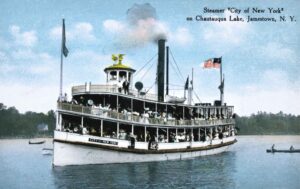 For more than 135 years, steamboats were one of the defining features of life on Lake Chautauqua. From the launching of the first steamer in 1827 to the final voyage of the City of Jamestown in 1963, steam navigation transformed the lake from a relatively isolated inland waterway into a transportation corridor, a tourist attraction, and by the 1880s the number one tourist destination in the entire United States! At their height in the late nineteenth and early twentieth centuries, large paddle-wheel steamers carried hundreds of thousands of passengers annually. They connected Jamestown, Mayville, Bemus Point, Lakewood, Chautauqua, Celoron and numerous smaller landings, carrying residents to work and market, tourists to hotels and amusement parks, and church and civic groups on excursions. In an era before good highways and automobiles, the lake’s steamers were both public transportation and entertainment.
Lake Chautauqua was already an important transportation route before the arrival of steam power. Native peoples and early settlers used canoes, flatboats and other small craft. There was even an unsuccessful experiment with horse-powered navigation. The first steamboat on Lake Chautauqua was the Chautauqua, built in 1827. Regular steam navigation began in 1828 with daily service from Jamestown to Mayville, a three-hour trip. The success of the Chautauqua quickly stimulated competition. The early lake fleet was not confined to large passenger vessels. Smaller steamers, ferries, freight boats and excursion boats appeared as communities and businesses around the lake grew.
From transportation route to tourist destination
The greatest transformation in the history of Lake Chautauqua came in the second half of the nineteenth century with the rise of the tourist industry. By the end of the 19th century, not only were there many large steamboats, but many lesser steamboats and other crafts plying the lake. Passengers could ride on the open decks, eat meals, socialize, enjoy the scenery and travel to resorts and amusement parks. Much of this traffic was servicing the tourist trade. Some twenty large resort hotels ringed the lake and dozens of other smaller lodgings, enjoying a symbiotic relationship with the steamboats. The largest hotel was the Grand Hotel in Lakewood, with some 400 rooms, and up to 1000 occupants. The largest steamboat on Lake Chautauqua was the three-decker Jamestown. It was 175 feet long with a capacity of some 3,000 passengers.
The other main mode of transportation were the railroads. The railroad reached Mayville in 1866. By the 1870s they were delivering tourists to the depots, primarily Mayville’s, for transit by steamboats to the area’s expanding lodgings. This change in transportation also made it possible to easily and inexpensively ship goods and materials into and out of the Mayville area and the local economy rapidly improved. For example, the harvesting, storage, and sale of lake ice to Pittsburgh started in 1871 when Adam Hersperger built the first large icehouse on the North end of the lake located in what is now Lakeside Park. The railroad placed a pier in the lake near their depot. The pier eventually came to be 50 feet wide, 300 feet long and was covered to shield passengers from rain and sun. Another pier and a coal dock to fuel the steamboats were also added. It was maintained winter and summer.
There was so much demand for steamboats that the Mayville area became a boat building location. Boats built in Mayville were both large and small. The steamboat portion of this presentation uses resources from the Fenton Museum in Jamestown for listings and descriptions. Pictures of a number of these boats are included. Other railroads and trolleys soon came from Jamestown up both sides of the lake. Property taxes paid on their right of ways and gradually gave the steam-boats competition. The money was often used to build and maintain roads and the rising use of cars and trucks led to the decline of transportation by boat. The lake’s steamers increasingly be-came recreational rather than essential transportation.
The decline of the steamboat
The decline was gradual rather than sudden. One by one, the large steamers disappeared. The City of Jamestown survived long after most of its contemporaries had vanished but made its final voy-age in 1963. The history of Lake Chautauqua steam navigation also mirrors the technological histo-ry of nineteenth- and twentieth-century America. The progression was remarkable: canoe → flat-boat → horse-powered boat → early side-wheeler → large paddle-wheel steamer → steel-hulled steamer → automobile and highway. However, the end of the historic fleet did not mean the end of the steamboat’s cultural importance. The memory of the old vessels remained strong enough that a new paddle-wheel vessel was eventually built to evoke the lake’s steamboat heritage. The Chautau-qua Belle, constructed at Mayville in the 1970s, brought paddle-wheel excursions back to the lake. The Belle is only one of five sternwheel paddle steamers currently operating in the United States today. The Belle makes regular runs through the main summer and fall tourist season.