By Carol Fisher-Linn
Don’t travel across the country to visit the Grand Canyon, we have our own at Letchworth State Park.
A visit to Letchworth State Park will bring out the ooohs and ahhhs you haven’t uttered often since you became an adult. But, to get the best “feel” for the park, you truly need to know its history to appreciate the land you walk on.
In 1743, Mary Jemison’s family came to the New World, settling near what is now Gettysburg, building a good life for their six children. Mary turned 15 during the French and Indian War, was abducted by the Shawnee who were friendly to the French and ended up at Ft. Duquesne where she was sold to the Seneca Indians. Adopting her, they named her “Dehgewanus.” She married a native, had one child who survived and, with her newborn in a cradleboard, they began a seven-hundred-mile journey – on foot – to her husband’s homeland along the Genesee River. She and the baby arrived at Little Beard’s Town near Geneseo. Her husband died enroute. Eventually remarried, the couple and their six children lived peacefully until that peace was shattered by the Revolutionary War. On the run again, they settled near old Beardstown and resumed their Seneca lifestyle. White man invaded once more bringing in land speculators and pioneers. In 1797, at the Big Tree near today’s Geneseo, a Great Council was held where most of the Seneca homeland was sold to the settlers The white woman, Dehgewanua, negotiated to acquire the Gardeau Reservation (18,000 acres). Unfortunately, life was never the same. Several of her sons were murdered and her lands were always challenged by settlers. Finally, in 1823 she reluctantly gave them up, reserving two square miles. Eventually she moved to the Buffalo Creek reservation. She was known by the Senecas as the “Old White Woman of the Genesee.”
When Dehgewanua died at 90 in 1833 her burial spot was eventually threatened due to yet another sale of Indian land. In the 1870’s her grandchildren approached the owner of their old family homeland, William Pryor Letchworth, who had begun buying parts of today’s park in 1859. He saw the devastation that was taking place on those lands and hoped to improve them. Over fifty years he planted over 10,000 trees, inviting visitors to enjoy the grounds. He also invited Dehgewanua’s people to bring their grandmother’s bones to his Glen Iris Estate. They reburied her on the bluff above the Middle Falls where visitors can visit her reburial site and statue … and perhaps ponder the story of all those lands that were once Indian lands. Be sure to stop at the historic Native Council Grounds and houses Letchworth also preserved.
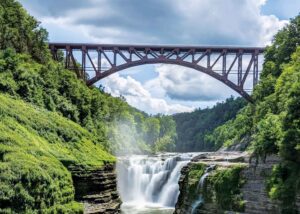
In years past, we who grew up visiting the park often, knew the best view was from atop the iron spider bridge railroad trestle which replaced the original Portage Wooden High Bridge. It was this view that encouraged Letchworth to buy the land so he could bring it back to its original beauty and preserve it. However, back then as today, the money moguls thoughtlessly destroyed nature in the name of “progress.” Letchworth, who had expanded his small home into a grander residence and had hired Frederick Law Olmstead to design the grounds saw the writing on the wall with hydroelectric dams at the Upper Falls being talked about by local industrialists. To stop it from happening, Letchworth presented a signed “deed of gift” to NYS in December 1906 with the donation officially accepted in 1907. Letchworth died in 1910 and the state, with the seed of this generous gift, expanded the preserved land into about 14,400 acres – now known as the “Grand Canyon of the East.”
The 17-mile gorge that inspired the nickname has cliffs up to 600 feet high, three major Genesee River waterfalls and an abundance of scenic overlooks. Middle Falls is the tallest – 197 feet and offers a predictable rainbow from the spray. Look for Inspiration Point and Great Bend Overlook. Visit the museum, enjoy the interactive exhibits at the Humphrey Nature Center and the one-mile loop Autism Nature Trail. Enjoy picnic areas, cabins for camping, pools, hot-air ballooning and whitewater rafting, in season. The Glen Iris Inn, aka Caroline’s, offers a fine dining experience after a day enjoying the park’s many recreational opportunities.
For a more thorough exploration into Letchworth Park History, google Exploring Letchworth Park History with Tom Breslin & Tom Cook.