
By Carol Fisher-Linn
St. Paddy’s Day – always a good time to celebrate, but what do we know about the Saint of the Emerald Isle?
In Bobby McCarthy’s days (Bobby was one of Ellicottville’s beloved past good will ambassadors and known as The Voice of Ellicottville), he served as Ireland’s envoy, guiding many of the Ellicottville community on memorable trips to the Emerald Isle, the place that held his Irish heart. They kissed the stone at Blarney Castle (upside down), sang Irish drinking songs at some of Bobby’s favorite pubs and perhaps even visited some of the 300 (pagan) stone circles on that small island. Through all their travels, even to the remote countryside, I can guarantee that they never saw a single snake. “Of course, they didn’t” you may say, “because everyone knows that Saint Patrick, Ireland’s patron saint, whose memory we commemorate on March 17th (anniversary of his peaceful death in 461), banished snakes from Ireland.” Except …
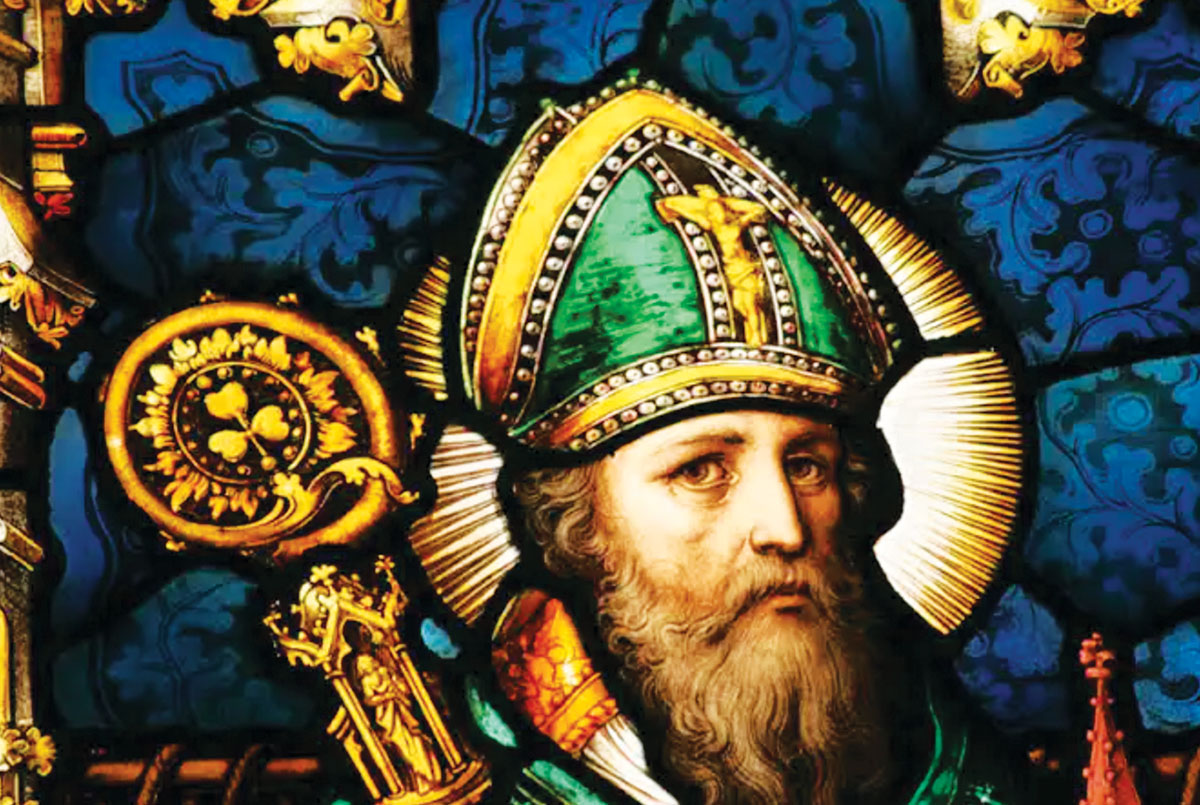
Let’s talk about it. Advocates of Saint Patrick (born approximately 390, died 460) hold tightly to the story that he banished Ireland’s snakes. But here’s the rub, and a lesson in world geographical history. According to a website named Boreas, back in the Ice Age (+30,000 to 14,000 years ago) Ireland, like many parts of the earth, was literally covered by a thick ice sheet “at times during the last glacial period, … Britain, Ireland and the adjacent continental shelf were almost completely covered by a kilo-meter’s thick ice sheet.” One kilometer would be roughly the distance from the 1887 building in the center of Ellicottville to the old Depot Restaurant near the entrance to Holiday Valley. Stand that on end and you can easily imagine how much ice covered Ireland.
About those snakes: The conditions following the Ice Age made Ireland an uninhabitable setting for cold-blooded reptiles like snakes. The dominant cold climate and the rapid disappearance of land connections meant snakes had neither time nor suitable conditions to populate Ireland. And then, there are the cold and treacherous waters of the Irish Sea separating Ireland from Great Britain. Mother Nature established a continuous geographical barrier that prevents natural snake establishment or homemaking. This unsuitability of the marine environment for terrestrial snakes, coupled with the significant distance, has ensured Ireland’s continued isolation from wild snake populations. Forever. Those of you suffering from ophidiophobia can breathe easily in Ireland.
Yet, the legend persists. We know snakes can’t live in Ireland so what are the story tellers talking about? Since old wives tales sometimes do not have credence, scholars step in to sort things out. According to the scholars, the story of Saint Patrick sending snakes wiggling off to other parts of the world likely is a metaphor. Serpents have historically been used as a symbol of evil (garden of Eden) or paganism. When the Celts came with ancient druids to worship natural deities, their “religion” was formed by pagan beliefs and rituals. This is the culture Patrick stepped into. Well, he was kidnapped by Irishmen at age 16 where he slave/shepherded in Ireland for 6 years, escaped, returned home to Britain (he was not Irish), had a vision telling him to bring Christianity to Ireland, became a priest and returned.
He was wicked smart, using their own traditional pagan rituals as part of his lessons of Christianity: pagan bonfires celebrated Easter instead of honoring their old gods. He used the sun, an Irish symbol, and superimposed it onto the Christian cross (now the Celtic cross) so they just simply transferred a familiar symbol to another. The Druids considered four-leaf clovers representing earth, air, fire and water to have mystical powers. St. Patrick used the three-leaf clover as a metaphor for the Holy Trinity. We call him Saint Patrick but he was never officially canonized as a saint in the Catholic church, but rather one by popular acclaim as was common in those times. But that doesn’t stop us from celebrating his legacy locally in Buffalo (Sunday, 3/15 – Delaware Ave., 2pm) or Jamestown (Saturday, 3/14 where they turn the Chadakoin River green at 10am and River Walk parade at 11.
Wear the green and celebrate St. Paddy’s at The Pub, Jamestown, Ole Hickory Tavern, Salamanca, Reubens and corned beef at Madigan’s, corned beef and shepherd’s pie at Mill Street, Party till your shamrocks really rock at Guppy’s on Bemus Point or enjoy a good spring run in St. Pat’s Dash with the Chautauqua Striders in Jamestown. St. Paddy’s Day fun for everyone.
Sláinte!