
By Dan Balkin
Before the revolution in ski design in the 1980s and 1990s, all skis looked like supermodels: Tall, beautiful, and skinny. Beautiful? Absolutely. Before shaped skis and wider “fat” skis appeared, we loved our long straight skis. Not having an idea a revolution in ski design was coming, ignorance was bliss. Last year, in a previous column, we explored how shaped skis were born and evolved. This column is about the other revolution in ski design: Fat / wider skis with “rocker” for skiing powder, broken / mushy snow, and for many people, their skis of choice even here on the eastern “Ice Coast.”
In the 1980s, someone in Austria watched a snowboarder elegantly surfing through powder snow and had an idea: What would happen if I cut a snowboard in half and put ski bindings on the two pieces. Crazy? Of course, most brilliant ideas are. That someone was named Rupert Huber, and he worked for the ski manufacturer Atomic as a ski designer. He followed through with his idea and found that the dissected snowboard – now two very sloppy looking skis – was far easier to ski in powder than the commonplace tall and narrow straight skis. By 1988, the prototype dissected snowboard formed the template for the world’s first mass-produced fat ski, the Atomic Powder Magic, also fondly known as “The Fat Boy.” The wider width made the skis much easier to float and turn in powder snow. Sounds simple now, but skis had been stuck in a ski design rut where it was assumed skis needed to be tall and narrow.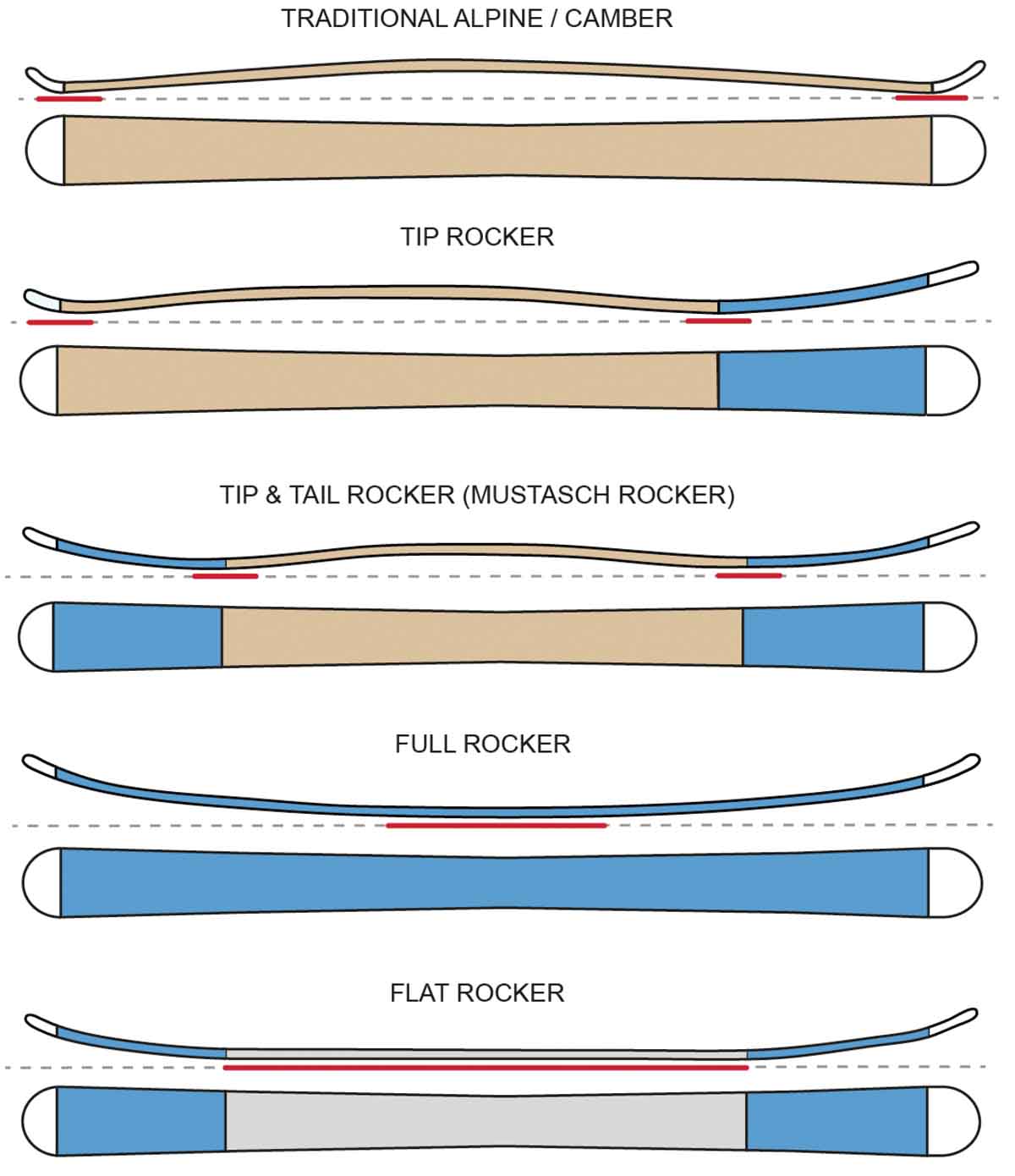
Once Atomic’s Powder Magic was available to the skiing public, other innovators began to think how fat skis could be made even better. Enter American skiing legend Shane McConkey. Shane was an extreme skiing expert, one of the guys who starred in videos hurtling off cliffs and skiing down death defying, steep chutes. He was born in Canada, had an itinerant childhood, and eventually based himself in Olympic Valley, California. McConkey started out as a ski racer and went to The Burke Mountain Academy in Vermont – one of the premier racing academies in the U.S. But extreme skiing beckoned, and he followed his bliss. He was a deep thinker and made several remarkable contributions to modern ski design. His most notable was the idea that to ski powder, do not just look at snowboards as earlier powder ski designers did, but look at water skis.
Most skis have something called “camber,” which is most evident in the top ski in the ski design drawing. That style of ski is still used by racers and some expert recreational skiers who seek edge grip and precision on firm snow. Although he had been a racer, McConkey realized that deeper powder snow would benefit from a new ski design. The designer in Austria looked toward the snowboard’s width for inspiration; McConkey looked toward the upturned tips and tails of water skis. He mounted ski bindings on water skis and took them powder skiing. Voila – it worked! Water skis have a much more “rockered” tip and tail than traditional alpine skis. This means the curve in the tip and tail is much more pronounced in its upward arc. If one looks at the bottom four skis in the drawing, it shows how McConkey’s “rockered” design evolved into various forms. Using a bit of rocker, especially in the ski tips, is also now commonplace in skis designed primarily for groomed ski trails. Shane also had another deceptively simple yet brilliant idea: Use rocker technology while making fat skis yet wider. These technological innovations were originally adopted by the Volant Spatula and later by the K2 Pontoon skis and made powder skiing even more user friendly than the original Atomic powder skis from 1988. In short, all these innovations brought “Powder to The People.”