
By Carol Fisher-Linn
Commemorating Black History Month: Why men and women risked their lives to help others….
Slavery is monstrous, vile, inhumane. Webster defines it as “the state of a person held in forced servitude, … or a condition of subjugation, and hard, grueling labor … It signified the state of being entirely under the control of another, often referred to as bondage.” The state of being entirely under the control of another … Think about that. This abomination called slavery began in 1619 in the colonies. A ship from Africa arrived in Virginia, bringing 20+ enslaved human beings. To be clear, Spain and Portugal had already been dealing in trade of human beings since the early 1500’s but 1619 was when it officially happened on the land that would become the United States of America. Enslaved Africans were already present in Spanish-controlled Florida as far back as 1528. Slave trade. Human beings snatched from their homes, imprisoned and sent to unknown, faraway lands, likely never to see their home or loved ones again.
Human beings for sale to the highest bidder. Let that sink in.
Before 1793, slavery was in decline – due to low profitability of staple crops (tobacco, rice, indigo, cotton). The call for more slaves was declining. By 1804 most northern states had abolished slavery. Things changed in 1793 when a white Yale College graduate, Eli Whitney (not the same Eli Whitney from Cattaraugus, NY), took an existing crude tool and ideas from the slaves who used it, and created/patented a machine to remove cotton seeds, creating cleaner cotton. Unintentionally, the cotton gin reversed the decline of slavery by creating the now profitable product – cotton. This information from History in Charts, explains how “King Cotton,” aka “white gold,” became an extremely lucrative crop that could be exported to more profitable European markets. Cotton farmers needed more land which eventually led to laws to support industry like the Indian removal Act of 1830 making appropriated, previously Indian-owned land available for the cotton farmers to expand across the south. Alas, this avarice and disregard for human life became a critical factor that led to the Civil War. Sadly, even the “business” of owning and selling human beings became profitable, regardless of the 1808 U.S. ban on foreign slave trade, with America’s slave populations increasing from about 900,000 in 1800 to 4 million human beings bought and sold in 1860.
These persons, with no individual or civil rights could not plan their own lives, vote, own property, or be guaranteed that their families would stay intact (they did not), were considered personal “real estate” passed down to the next generation like grandma’s old silver. The passage of the Fugitive Slave Act of 1850 which imposed harsher penalties on those who helped slaves escape also incentivized the kidnapping of blacks, free or otherwise. Free blacks were already living in the north, so this new law set the northern states on the path of finding ways to protect these persons and get them to safety in Canada, even losing some of their own productive black community members. This forced northerners into action and thus many became abolitionists responsible for the formation of the U.G.R.R. (Underground railroad) to move these runaways from the south through the American north.
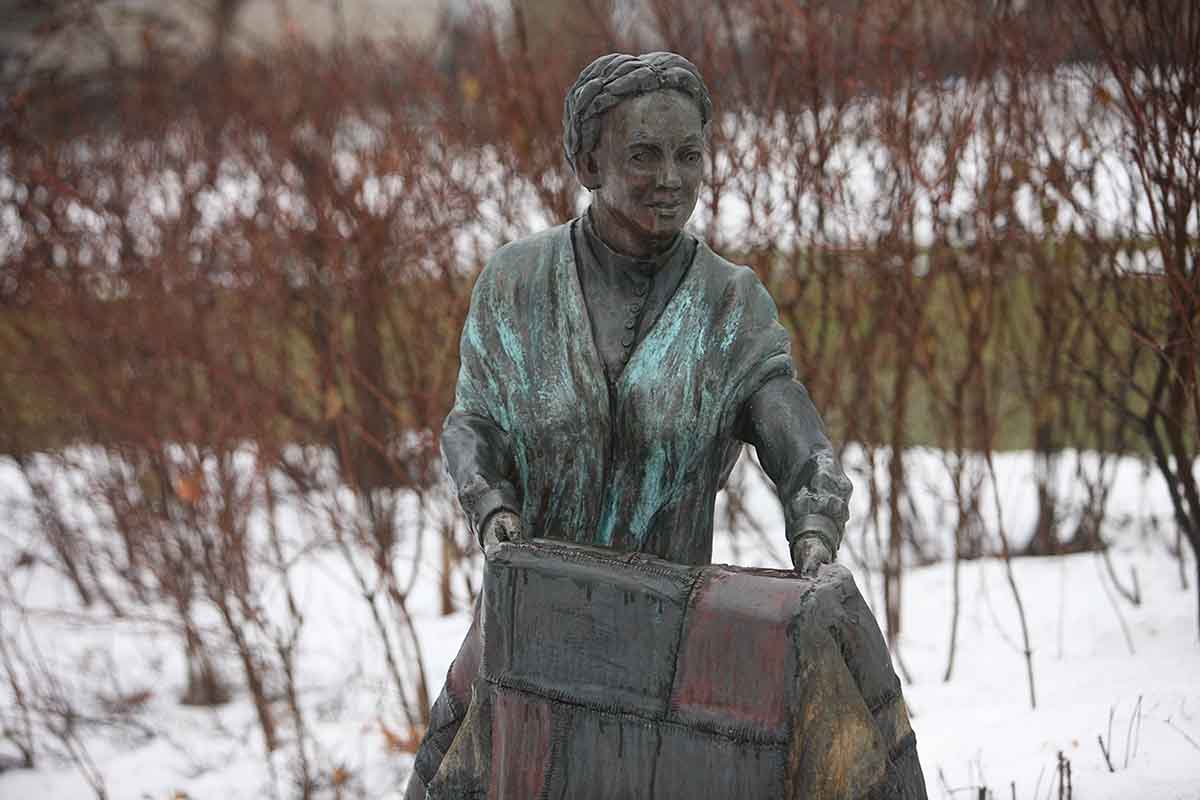
Locally we can find reference to persons involved in this rescue operation across the state. In Cattaraugus and Chautauqua counties, hundreds of underground railroad individuals moved these runaways using the Allegheny River, Ischua Creek and numerous back roads or paths through towns like Olean, Ellicottville, Cadiz, Jamestown, Sherman, Versailles, Dunkirk, etc. A memoir written by a Chautauqua County U.G.R.R. conductor, Eber Petit, The History of the Underground Railroad, names persons and places of those who gave refuge, food, clothing and means of travel at great personal peril to themselves and their families. The Darwin Baker Museum in Fredonia and The McClurg Museum in Westfield both have displays accounting these events. The Fenton History Center in Jamestown holds information about stationmaster, mixed-race Catherine Harris – likely the very first “colored person” in 1831 Jamestown. In 1835 she moved into a 16-foot Long House (which allegedly could hold up to 17 runaway in its attic!). She was one of the few blacks to maintain a station. Her bronze statue stands in Dow Park.