
By Bill Burk
Do a quick thought experiment before reading on. Make ice without electricity. Of all the day-to-day comforts we take for granted, the human ability to create cold might be the most underrated (heat was a piece of cake). Refrigeration, other than via of evaporation and air movement, wasn’t invented until the 1830’s. It wasn’t perfected for another century. There is no reliable data that recorded how many refrigerators were in United States homes prior to 1940, but it wasn’t many (by 1944 they were in about half the households). If you wanted something cold, it meant ice. Ice harvest on Chautauqua Lake was a booming business from the 1880’s through the 1910’s; twenty to forty-thousand tons removed from the lake yearly and shipped to ice houses, mostly in Pittsburgh, but west to Cleveland and east to Buffalo as well. Ice was a regional industry that moved tens of thousands of tons of product and employed entire work forces through long winters. Chautauqua Lake has a low shoreline, easily accessible. The upper basin has a depth best for growing ice. By late January every year crews had laid out a cutting schedule, dividing the ice into a grid of blocks twenty-two by thirty-two inches, with a depth of twelve to eighteen inches. Blocks weighed between a hundred-fifty and three-hundred pounds. Giant saws cut up the grids and horse-drawn sleds pulled the ice onto shore. Ice was loaded onto wagons and transferred to train stations. The blocks were standardized to maximize storage. A single railcar could carry thirty to forty tons of tightly packed ice, and during the busiest weeks, multiple cars departed daily for industrial centers. Ice from Chautauqua Lake was known throughout the east for its clarity and slow melt rate, qualities that reduced losses during transport and increase its commercial value. A block of Chautauqua ice could last ten to twelve months if stored correctly.
The Celoron Ice Company and facilities in Mayville maintained storage capacity for more than ten-thousand tons, not simply stacks of frozen water, but inventory, revenue, and the wages of hundreds of workers. Families depended on the harvest to bridge the financial gap between fall and spring.
But the industry operated on narrow margins, dependent on the weather. A solid freeze determined whether a year would be profitable. Mild winters, or untimely thaws, could ruin an entire harvest season, which trickled down to all the industry that counted on ice, including service to individual homes. This ice had to last until the next freeze and provide winter wages for ice workers, wages that were comparatively strong for the era—often $1.50 to $2 per day when factory work paid closer to $1.
Icehouses were feats of practical engineering. The Celoron structure was a massive wooden complex along the shoreline, insulated heavily with sawdust (sawdust was the perfect insulation, a limited conductor of heat, and cheap), it could preserve ice into September. Storage capacity was precise, every cubic foot represented potential income. A fully stocked icehouse could hold a value equivalent to hundreds of thousands of dollars in today’s dollars.
Before rail expansion, natural ice rarely traveled far from its source. Afterward, it became a critical component of food distribution, brewing, and industrial cooling across multiple states. Thousands of tons left the Chautauqua Lake with breweries among the largest consumers.
By the 1920s mechanical refrigeration technology began to offset the ice industry. Prices for natural ice, once $4 to $6 per ton, fell to $1. Profit margins collapsed. Icehouses that had operated for decades closed, buildings were dismantled, equipment was sold for scrap, and workers moved into factories, railroads, and other emerging industries. The transition happened quickly enough that many communities experienced it as a sudden end rather than a gradual decline. Chautauqua County was no exception, but in its halcyon days, frozen water from the lake was a major local business.
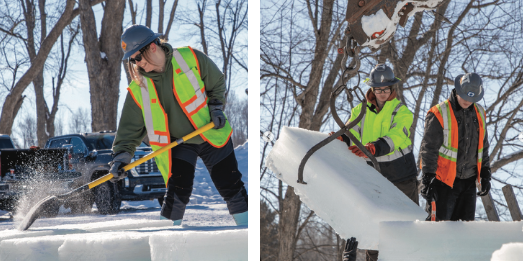
Thanks to the Mayville Community, we can share the experiences of ice harvesting at annual Mayville Winterfest, which will take place at Lakeside Park located at 50 W. Lake Rd in Mayville this weekend, February 13-15. This three-day community event is filled with fun activities for the whole family. The festival is a longstanding tradition highlighted by the great ice castle harvested from Chautauqua Lake and features winter activities, music, vendors and great food, all along the scenic lake.