
By Dan Balkin
Little did we know that Jedi Master Obi-Wan Kenobi was also referring to skiing when he told Luke Skywalker, “May the Force be with you.” We are not suggesting a Star War’s like “Force” that could make a ski lift levitate, but an everyday force that you can manipulate as you ski. Inclined slope, slippery, variety of snow conditions, gravity pulling you downhill. Sounds like skiing – right? You combine all those elements, and skiing generates a FORCE. That force can work against us – but also for us.
There is a great YouTube ski video created by former U.S. Ski Team member and Olympic gold medalist Deb Armstrong. It’s called “First day of the season, a focus for the advanced skier.” She is interviewing and skiing with Josh Fogg, the Director of Instructor Training at Aspen / Snowmass in Colorado. Josh is also a member of the PSIA National Team – the crème de la crème of American ski instructors. In that capacity, he travelled in 2023 to an event called Interski in Finland where national team instructors from all over the world convene to ski together and share ideas (the next Interski is in Vail, CO in 2027).
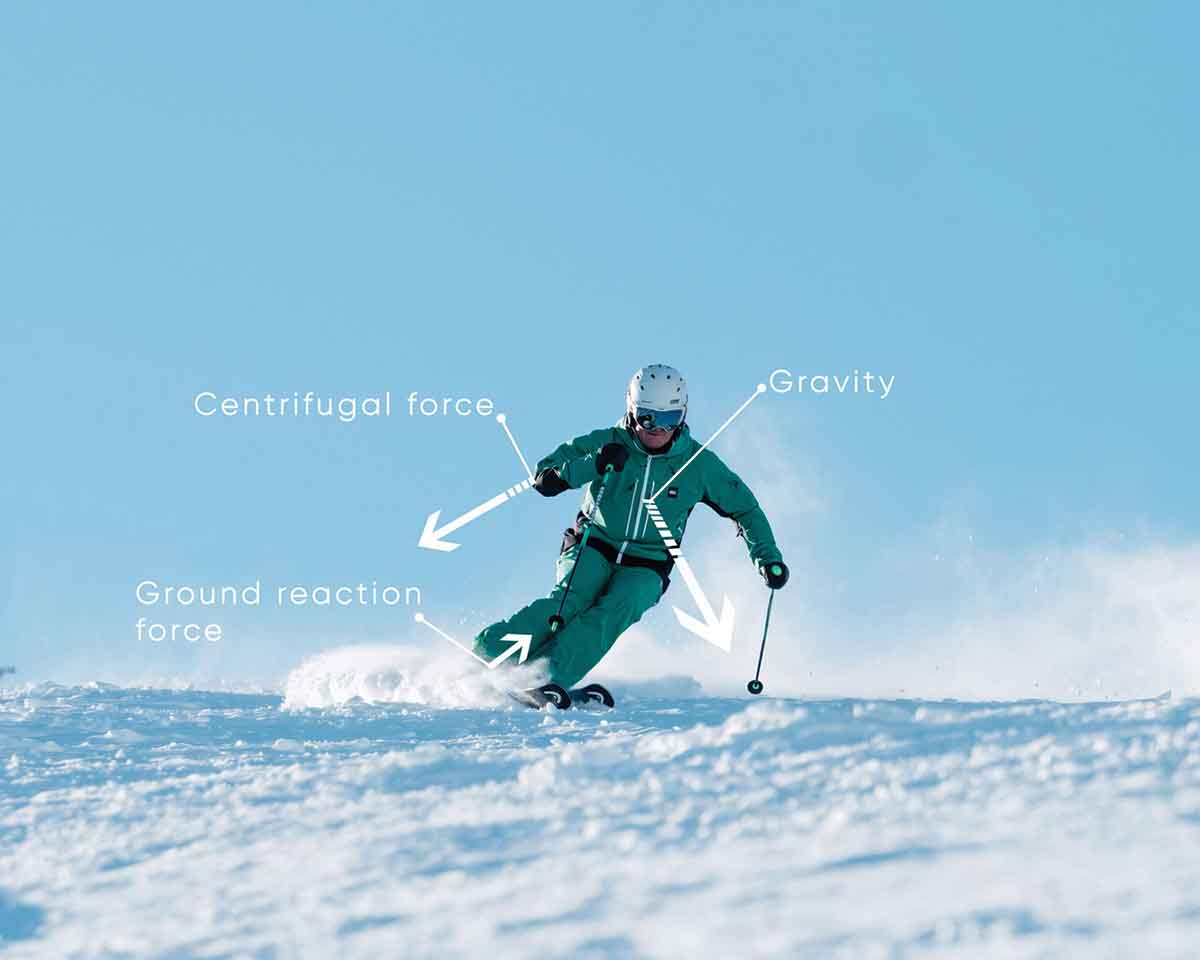
On a chairlift ride, about halfway through the ten-minute video, Josh said he went to a presentation by the Austrians at Interski. He remarked that the Austrians said that “Advanced skiing is about aligning your body to smoothly absorb the forces coming at you.” Aha moment! I thought, if someone asked me to explain advanced skiing in one sentence, this is the one I would use. Why? Please look at the photo. There are a variety of forces generated in skiing, but the two most important for recreational skiers are gravity and ground reaction force. Complex? No. In the first half of a ski turn, we use gravity to propel us down the slope; in the second half of a ski turn we regulate our speed by allowing the snow-covered ground to push back against us.
Disclaimer: If this intrigues you, please watch the excellent YouTube video as you will get more out of it than these words and one photo can convey. Please look at the photo of the skier again. He is, as the Austrians insisted, absorbing the forces generated by his ski turn. How? By assuming the same balanced body position that hockey players, soccer players, football players and kids playing tag all assume as they twist and turn to dodge opponents. In other words, as the photo shows, we don’t lean like the Tower of Pisa to stay in balance while turning. Instead, we position our hips to allow our legs to tip closer to the slope (for edging) and angle our upper body to tip away from the slope (to balance on the downhill ski).
This balanced position can be felt most easily when our hips are orientated correctly – toward downhill. Remember, it’s not a contrived but a natural position the body uses to balance while turning. Whether wearing a belt or not, always think about your “belt buckle” being orientated toward the downhill ski – like the skier in the photo. This puts your hips in the correct position to naturally allow your body to feel balanced while turning. Thinking about something like a belt buckle is called an “external cue” (outside of the body), and they have proven to be highly effective at improving movement patterns across all sports. Again, in the photo, the skier’s “belt buckle” is oriented toward his right (downhill) ski as he makes a turn to the left. If we imagine him transitioning to his next turn, his “belt buckle” would momentarily unwind to face his ski tips and then be reorientated to face his left (downhill) ski to make the following turn to the right. Try it, feel it, play with it. It works! Thinking of your belt buckle always being orientated toward your downhill ski helps you find the natural body position that absorbs forces. Remember – you did this naturally with your hips playing tag as a kid. Listen to your inner Obi-Wan and let the Force – and belt buckle – be with you.