
By Carol Fisher-Linn
In one year and one day, Shea’s Buffalo “Wonder” Theater sprang up on Main Street (January 16, 1926). Here’s an historical perspective of the early 1900’s when the era of elegant theaters was in full swing. The Gilder Lehrman Institute of American History instructs us that following the 1890’s depression, “The modern business corporation, modern politics, the modern presidency, a modern vision of the international order, and modern consumer capitalism were all born in these years.” It was the progressive era of electricity, boom-and-bust cycles, new immense wealth, urban poor, struggling farmers, Andrew Carnegie’s steel and iron empire, and Ford’s Model T.
Buffalo was truly a “happening” place. Why? Buffalo was among the great cities in the US. (8th largest, and 6th busiest water port IN THE WORLD). In 1926, the year the theater was opened, Hollywood was the center of the movie industry and Buffalo was THE town to show those movies. It is in this era of vaudeville, variety stage revues and silent movies that Shea’s Buffalo theater emerged through the imagination and industry of Ontario born/Buffalo-First Ward raised Irishman Michael Shea who, as a very young teen became a structural ironworker on Buffalo’s railroad bridges. “Iron Mike” as he was called, (known for fighting on top of those bridges) was at home among cursing, sweaty iron workers or tough seamen, but his artistic/entrepreneurial soul prodded him into another direction. First, he opened a saloon, then with his earnings and a borrowed $2500, opened Shea’s Music Hall in 1882. It burned in 1893. He began again, eventually opening The Hippodrome on Main/Chippewa in 1914, the first motion-picture house between NY and Chicago. By 1924 he owned 12 movie theaters and four vaudeville houses. He then teamed up with Paramount. In the golden era of movie houses a two-million dollar theater came to Buffalo in one year, with one steam shovel (some say) and hundreds of workers. The “marble” is plaster worked artistically by several Italian immigrants, who created walls, columns and sculptures using their special technique. With highly trained, uniformed ushers, The Wonder Theater as it was known, designed by Tiffany, furniture from Chicago’s Marshall Field’s and Czechoslovak crystal chandeliers opened with an acre of seats (4000-now 3019) and a mighty Wurlitzer (the voice of silent films). A ticket got patrons the news, music from the Wurlitzer and the film/show.
Shea had the respect of everyone, from the people who worked for him to the greatest stars of stage and screen. Many came to Buffalo just to be with that legendary, two-fisted Irishman, Mike Shea, also a fitness nut, which is truly why there are no elevators in the old Shea’s. (Elevators are coming.) An inveterate showman, Shea did stunts like bringing elephants and camels to parade down Main street promoting the movie, The Valley of the Kings.
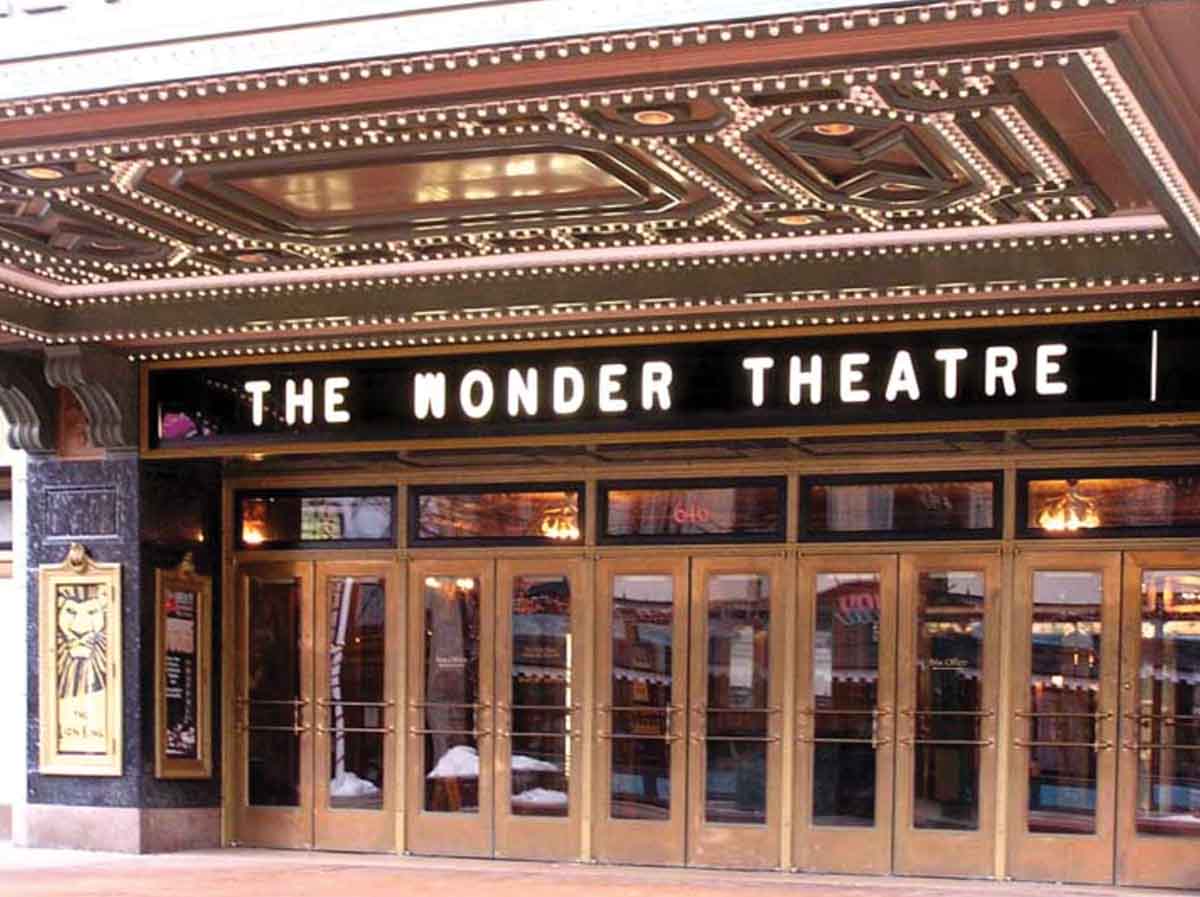
as Wonder Theatre sign and brass doors were in-
stalled in 2004.
Hard times hit with The Great Depression – Shea’s did not close. They kept people employed. Shea retired in 1930. By 1950’s Americans had TV and local movie theaters. Shea’s sold to Lowes and only ran movies and eventually closed. By 1964 Buffalo developer Leon Sidell bought and reopened Shea’s which kept it alive. He lost it to city. Eventually it was slated for the wrecking ball. A Lowes engineer Curt Mangel, literally lived there, inventoried, etc., and eventually started the Friends of The Buffalo Theater group which legally stopped Lowes from removing items from the theater. City Comptroller, George O’Connell, another Shea’s hero, refused to sign for the wrecking ball. Ultimately, Shea’s became listed on National register of Historic Places and hope was renewed. In 1980, the Shea’s O’Connell Preservation Guild began management of the building and continues operation today. Massive renovations inside and out made it possible to bring to Buffalo Les Miserables, Miss Saigon, and Phantom of the Opera.
The 1926 the $72,000 Mighty Wurlitzer had major water damage, with mushrooms growing inside. Maureen Wilke and a team came to the rescue, repairing the wooden pipes to begin restoring the organ. Renovation took upwards of $400,000. Did you know that the organ has actual percussion instruments within it that are airpower activated with the press of a lever? From the organ to the building, it is truly a Wonder.