By Dan Balkin
Our story begins when Howard Head, the inventor of metal skis, was a young man and by his own admission, a rather mediocre athlete. In 1947, he decided to give skiing a whirl by taking a trip to Stowe VT. Head was a Harvard educated aeronautical engineer. Predictably, his engineering prow-ess alone did not help him as he struggled to negotiate Stowe’s legendary and challenging trails on a pair of wooden skis. Sure, it did not help that he was a novice skier from unsnowy Baltimore – but something about wooden skis stuck in his craw. He aeronautical mind reasoned if airplanes had ditched wooden for metal construction after WWI – making them safer and more reliable – why were skis still being made from this natural yet archaic material? Had he been a gifted athlete, he might have found his initial ski outing less challenging. Fortunately, for skiers everywhere, he blamed the outdated technology of wooden skis for spoiling his fun.
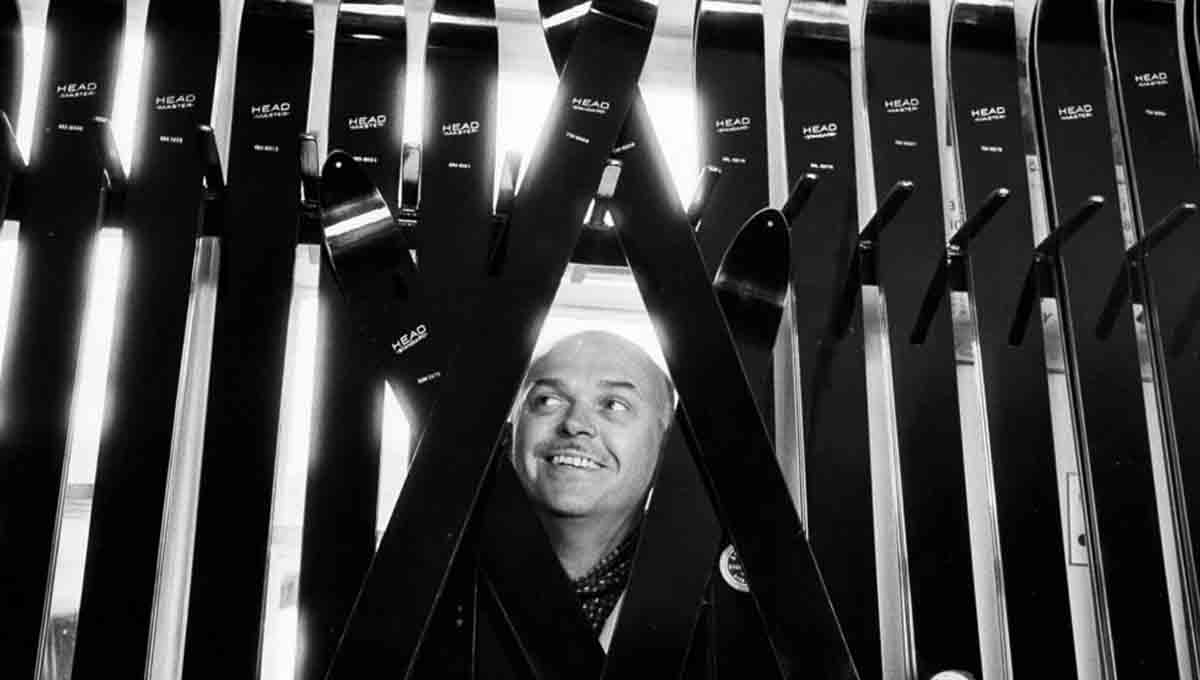
Howard Head had a vision to transform skis, but not enough cash to do it. Good fortune, however, for both Howard Head and skiers stuck on wooden skis was looming. What Howard lacked in athletic ability was offset by a terrific skill at playing poker. Determined to make the world’s first metal ski, he quit his aeronautical engineering job at Glenn L. Martin Company (later part of Lockheed Martin) and survived on his poker prowess. One night in the late 1940s, he made $6,000 playing poker (adjusted for inflation, the equivalent of $81,000 today!), which turned out to be crucial seed money for the foundation of the Head Ski Company. It is estimated that Thomas Edison made almost 3,000 light bulbs that failed before he had his eureka moment. Howard Head also found that, even using the expert skiers he recruited as testers, his first “metal sandwich” skis would often bend like pretzels, fall apart, delaminate, or break in pieces after one or two runs. But, like Edison, who said “Genuis is one percent inspiration and ninety-nine percent perspiration,” Head perspired, persevered, and learned from his failures.
By 1950, he developed a legendary and durable metal ski known as the Head Standard. As the joke went about the Model T auto in the 1920s, in the 1950s you could get the original Head skis in any color as long as it was black. The public did not care. Each ski was constructed using layers of metal, a plywood core, and a plastic base. These new metal skis were three times more flexible than wooden skis, making them far easier to turn and more forgiving. The reaction was immediate and predictable: Wooden ski traditionalists labeled them “cheaters,” – but the public embraced them. Suddenly, skiing became far more accessible for the masses and sales of Head Standard skis sky-rocketed. Newfound metal ski converts included mere mortals, legendary racers, high profile instructors, and Olympians alike. By 1971, Head sold his interest in the Head Ski Company to AMF for $16 million.
His athletic mediocrity, however, was to produce more rich fruit. Just as he was originally a frustrated skier, Head was a frustrated tennis player. His engineering mind, which asked why skis were made of wood, now asked why the sweet spot to hit the ball on a tennis racquet was so small? His solution was to invent the first commercially viable oversized tennis racquet, leading to the iconic Prince Classic. This, again, made the $6,000 in poker winnings that kick started his business career look like a pauper’s payout. In 1982, he sold his controlling share of Prince racquets for $62 million (about $215 million today).
Maybe money can’t buy love or happiness, but it can buy philanthropy. Howard Head had a kind heart and lived the rest of his life donating large sums of money to worthy causes. Bless him.