
By Dan Balkin
Our enchanting Buffalo Christmas story can be traced back to 1816, when a Catholic priest in Austria, inspired by the miracle of Christ’s birth, wrote a beautiful poem in German. Translated into English, we know the poem as the lyrics of the song “Silent Night.” Two years later, in 1818, the priest presented the poem to a young organist at his church and asked him to compose music for the song. The result? A Christmas miracle. The world was bequeathed a song whose radiant light will never dim. At first, Silent Night was only known as a local treasure where it was being sung in a tiny church in the Salzburg region of central Austria.
Then fate, or the Hand of God, intervened. The organ that first played Silent Night in a small village near Salzburg malfunctioned, and an organ repairman / builder traveled about 100 miles from another Austrian village called Fugen to rebuild it. Smitten by the song, the organ mechanic brought Silent Night back to his local church in Fugen. It so happened that the town had a talented singing family named Rainer. Today, generations of the family are commonly known as the Rainer Family Singers and are legendary in their native land. The Rainer Family Singers, captivated by the sacred beauty of Silent Night, sang the song before emperors, czars, and kings in Europe. Not to be outdone by the royals, ever larger crowds of common people thronged to concerts to hear the Rainer Family sing Silent Night.
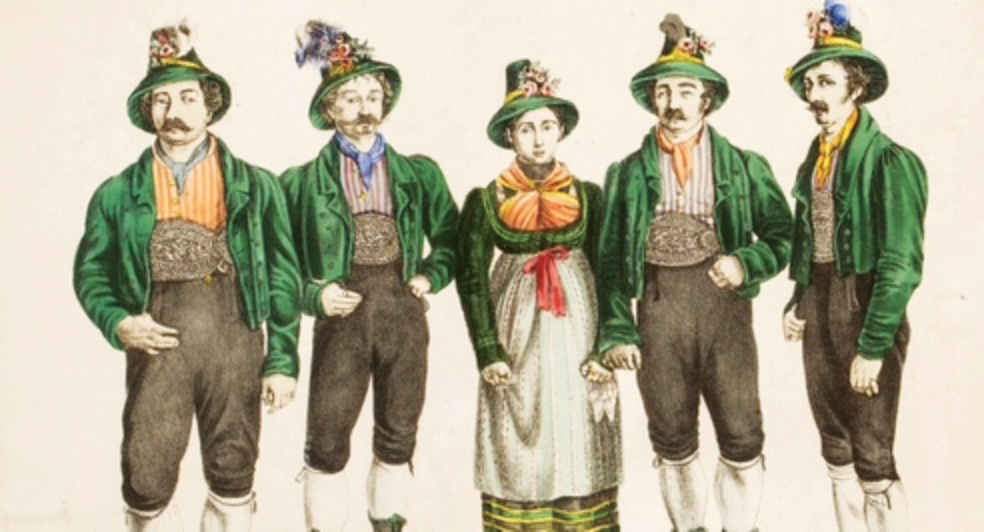
But Buffalo and Silent Night? Yes. As a young man, I lived several villages up the valley from Fugen, where the Rainer Family Singers originated. One day, a British friend I was skiing with said to me, “You’re from a place called Buffalo – right?” He then told me he had been poking around in the town of Fugen (hometown of the Rainer Singers, about 12 miles away), entered the church graveyard, and saw a tombstone with the words “Buffalo USA” engraved on it. I was incredulous. In this corner of the world, no one sported a Bills sweatshirt or gnawed on chicken wings. How was it possible that Buffalo – a place separated from this graveyard by a vast ocean and thousands of miles – could be engraved and commemorated on a nearby tombstone?
Intrigued, I drove 12 miles down the valley to Fugen. The small yet quaint graveyard sat alongside the village’s lone Catholic Church; the tombstone was easily found. This was long before cell phones with cameras, and to be honest, I don’t recall the women’s name or exact year of her passing (it was sometime in the mid-1900s). But very clearly and deeply engraved into the tombstone were the words “Geboren Buffalo USA.” (Born in Buffalo USA). I was mesmerized and stared at the tombstone for a long time. Thoughts of home flooded my mind, and I wondered how this woman from Buffalo could possibly be buried here? When I saw the tombstone, I knew nothing of the Rainer Family Singers. Returning to the village where I lived, I asked some locals how this was possible? They explained that the Rainers had a long history of touring America. They first came to our shores in 1839 to sing Silent Night and generations of their descendants continued this touring tradition until the early 1900s. At that time, Buffalo was one of the American enclaves where recent German speaking European immigrants still conversed in their native tongue. That cultural affinity led to the Rainer’s to put Buffalo on their touring itinerary. During one of these early 1900s tours, a young lady from Buffalo met one of the Rainer Singers. Love blossomed, and she eventually returned with him to his native village of Fugen, Austria and became his wife.
Who could imagine that a priest, inspired by his love of God and the Holy Family, would write a poem in German that would eventually evolve into a celebrated carol that would lead a woman from Buffalo to find her bliss in the Rainer’s home village of Fugen, Austria – the village from where Silent Night was spread throughout the world? God did. Merry Christmas.