By Carol Fisher-Linn
There is no better time of year to give thanks for individuals who may not have been born in our region yet gave so much to us and left profound legacies. This week we will spotlight two of these individuals.
Ellicottvillians and Buffalonians alike owe much to a Quaker man, Joseph Ellicott, a surveyor, born in Bucks County, Pennsylvania, 11.1.1760. His older brother, Andrew, was also a surveyor and his younger brother was a U. S. congressman. In 1790 Andrew was hired by the federal government to survey the new federal district where the capital city of Washington was to be built. Joseph was Andrew’s assistant. He was later called upon to survey property in western Pennsylvania purchased by a group of Dutch investors who formed the Holland Land Company. When they purchased a huge tract of Western NYS, Joseph was hired to survey it, beginning in 1797. He spent two years living outdoors in both summer and winter, laying out the townships, completing the Great Survey of the land in October 1800, when he was named the principal agent of the company in a land office in Batavia. Until 1821 he supervised all sales of the tract, personally signing many of the deeds. In 1801 he laid out Batavia, in 1804 the village of Buffalo, creating mill sites and communities. He was an ardent advocate for a canal to be built and in 1825 the Erie Canal became a reality. He was known to offer generous terms to buyers, even accepting 25 cents down and rearranging terms if it proved difficult to pay if improvements had been made on the properties. Ellicottville’s first land contract issued by Holland company was in 1813, Ellicottville was designated county seat in 1817 and the village was finally incorporated in 1837, the first to hold a village charter. It is through his genius that Ellicottville has the clean and navigable layout it has and is why our community is named Ellicottville. His layout also distinguishes the City of Buffalo. Ellicott never lived here, but he left an indelible mark for which we are grateful. He never married. In his later life, he suffered from serious mental problems and was admitted to an asylum in NYC. Here is where he hung himself, in 1826. He is buried at the Batavia Cemetery. There are many places, streets, and buildings named after Ellicott across Western New York, especially in Buffalo/Orchard Park, Batavia and Ellicottville.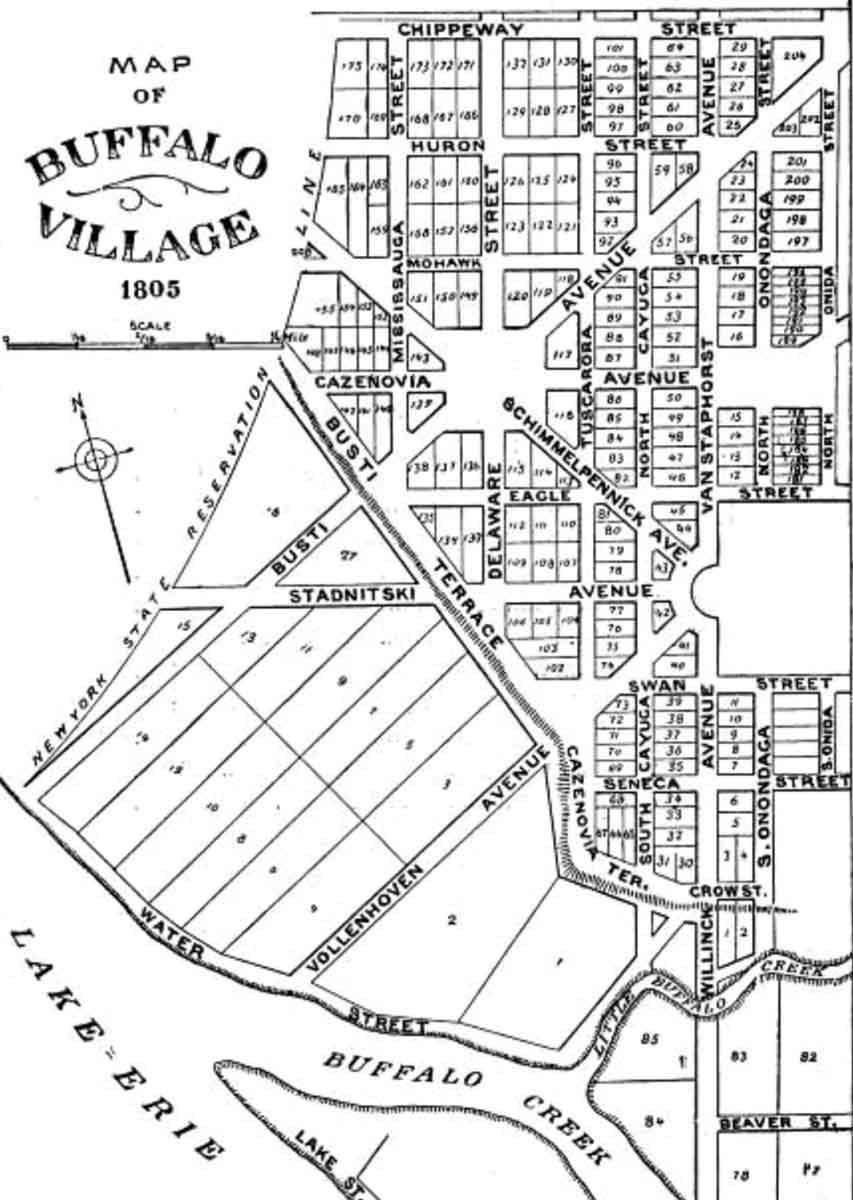
Another gentleman who impacted this region tremendously but was born elsewhere is St. Bonaventure University co-founder, Nicholas Devereux. He donated the land on which the university and community are built and had the support of Bishop John Timon of Buffalo, NY and Italian members of the Franciscan Order.
Nicholas Devereux (1791-1855) was an Irish-American financier and banker, and one of the major early landowners in Western New York State. Born in Ireland, at age 15 he emigrated to join an older brother in Utica, NY, going into partnership in his firms and very successful, lucrative business dealings. By 1835 he bought 400,000 acres of Western NY which was the remainder of the Holland Purchase, including much of Cattaraugus, Allegany and Wyoming counties. His business interests led to banking (Curious note: On the wall of the bank was a gauge for measuring height for the purposes of identification, and a detailed physical description of each depositor was maintained in a memorandum book.) A state hospital was moved to Utica through his efforts, he was involved in the railroad, water works, steam woolen mills, and held increasing amounts of real estate. An ardent Catholic and philanthropist, he married and had six children. Saint Philip Neri church in Ellicottville was built in 1851 with Devereux’s involvement. He then had the idea to bring a Franciscan presence to the area so the priests and one lay brother from Italy began their ministry in Ellicottville, first with Devereux in his home, then in the Thomas McMahon house where the friars resided for several months after their arrival (near Tops location today). The second building was near St. Neri Church for which they had taken responsibility. It was their home for several years while the 1st college campus building in Allegany was built thanks to Devereux’s donation of land and $5000 to build a monastery. Nicholas Devereux died unexpectedly in in 1855 but his wife and family followed through with his philanthropic wishes.