
Carol Fisher Linn
George Mortimer Pullman was born in 1831 in Brocton, New York. His family moved to Albion, New York, along the Erie Canal in 1845, so his father
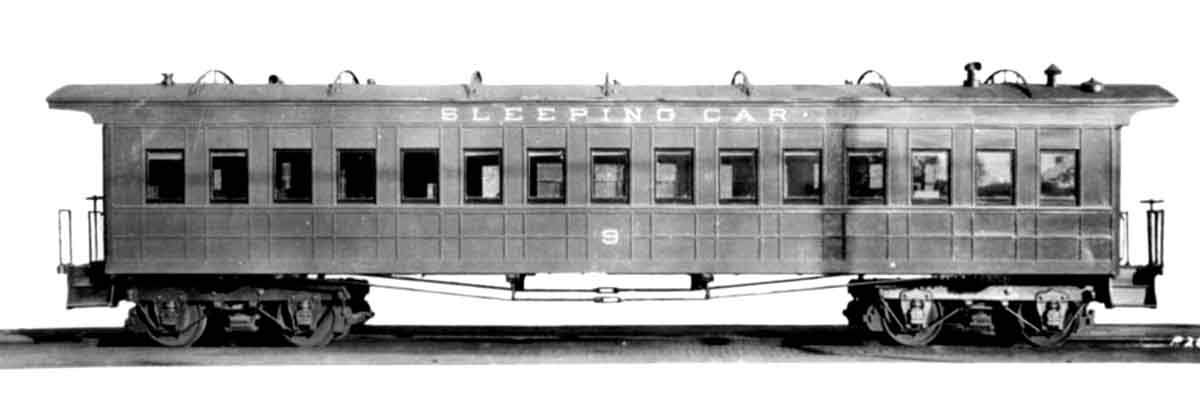
Industrialist, and Inventor, he is remembered for the design and manufacture
of the Pullman sleeping railroad car. A Pullman sleeping railroad car is a type
of railway passenger car that provides sleeping accommodations for overnight
travel. Operated by the Pullman Company, these cars were a symbol of
luxury and comfort in American rail travel from the late 19th to the mid-20th
century. Sounds great until you discover that he served as town “Baron” and
prohibited any freedoms like town meetings, independent newspapers, public
speeches, private charitable organizations or any open discussion. His family
buried him in Chicago in a lead coffin, sunk in concrete.
could help widen the canal. His father had invented a machine using jack screws that could move buildings or other structures out of the way and onto new foundations. Pullman attended local Brockton, then Albion schools and helped his father. In 1853, his father died; George took over his business at the age of 22 and relocated to Chicago four years later, still raising buildings. Engineer, Industrialist, and Inventor, he is remembered for the design and manufacture of the Pullman sleeping railroad car. In 1863 he established the Pullman Palace Car Company and it grew exponentially from there. He hired former slaves as porters becoming the largest single employer of African Americans after the Civil War. But they were hard-pressed to do triple duty as waiters, valets, plus entertainers. In 1880 he built a factory and a company town called Pullman which included housing and all amenities of a typical town (church, theater, parks, hotel, etc., but no saloons or vice districts). Sounds great until you discover that he served as town “Baron” and prohibited any freedoms like town meetings, independent newspapers, public speeches, private charitable organizations or any open discussion. Even when he cut wages, he did not cut rent, inciting a rebellion. He refused to meet with them, instead, he asked President Grover Cleveland to send federal troops to quell the strike. 34 people were killed, his reputation was tarnished and an investigative presidential commission condemned him. He died three years later of a heart attack at 66. His family buried him in Chicago in a lead coffin, sunk in concrete, the tomb reinforced concrete with steel rails and more concrete, to disallow his detractors from digging up his body and desecrating him. In 1898 the Supreme Court forced the company to divest ownership of the town, which was annexed to Chicago. (Information from a bio by William Biorstad).

2004. She is best known as a singer and songwriter for the
comedy folk duo Garfunkel and Oates with Kate Micucci
which was nominated for a Primetime Emmy Award for Outstanding
Original Music and Lyrics.
Erika “Riki” Lindhome (born late 1970’s) Erika Lindhome is a native of Coudersport, Pennsylvania, and raised in Portville, New York. She graduated from Portville High School in 1997, then on to Syracuse University, where she graduated in 2000. In 1997, she won first prize in the JFK Profiles in Courage essay contest awarded by the John F. Kennedy Library in Boston. She is now an actress, comedian and musician. She is best known as a singer and songwriter for the comedy folk duo Garfunkel and Oates with Kate Micucci. Her television debut was in 2002 with minor roles in the series Titus and Buffy the Vampire Slayer, she guest-starred on the WB series Gilmore Girls (2005–2006), the CBS sitcom The Big Bang Theory (2008; 2017) and the HBO series Enlightened (2011). She made her feature film debut in Million Dollar Baby in 2004 and has moved on to others through present. Their 2016 Vimeo comedy special Garfunkel and Oates: Trying to Be Special was nominated for a Primetime Emmy Award for Outstanding Original Music and Lyrics.
Alice Jane Chandler Webster, an American writer who wrote under the pen name, Jean Webster, was born in Fredonia NY. She lived her early childhood in a strongly matriarchal and activist setting, with her great-grandmother, grandmother and mother all living under the same roof. Her great-grandmother worked on temperance issues and her grandmother on racial equality and women’s suffrage. Alice’s mother was niece to Mark Twain, and her father was Twain’s business manager and subsequently publisher of many of his books by Charles L. Webster and Company. They moved to NYC for this business only to return to Fredonia in 1888. There she attended Fredonia Normal School, then moved on to Lady Jane Grey School in Binghamton, then finally to Vassar in 1901. During her school year she changed her name to Jean because a roommate was also called Alice. At Vassar she became interested in social issues including visiting institutions for “delinquent and destitute children,” becoming involved in the College Settlement House that served poorer communities. She maintained that involvement all her life. Those experiences paved the way for her first books, When Patty Went to College and Daddy Long-Legs. Through the years she wrote more novels and newspaper columns while traveling the globe and finally returned to Fredonia. She ultimately married Glenn Ford McKinney, an attorney. Her book Daddy Long-Legs became a play opening at Gaiety Theater in NYC. She sold Daddy Long Legs dolls to raise money for the adoption of orphans into families. She died in childbirth (1916) of her only daughter, Jean. Jean Webster is buried in Fredonia among family members.