By Bill Burk
Drive through the rolling hills of Cattaraugus County in western New York, and you’ll experience the heart of small-town America. Highway 219 carves a path through towns where modest homes cluster, small schools anchor generations, and the rhythm of rural life has a comforting predictability. Farms dot the landscape, trees crowd the horizon, the sky is gigantic.
What you won’t see, or feel, or hear, or even think about (until now), is the cache of nuclear waste buried in a facility called The West Valley Demonstration Project (WVDP).
In 1954, the U.S. Atomic Energy Commission sought to break up the federal monopoly on nuclear fuel reprocessing (taking spent reactor fuel and extracting usable materials like uranium and plutonium) and allow states to handle the process. In 1961 New York State embraced the opportunity and acquired 3,300 acres of land in Cattaraugus County, aimed at attracting private investment. West Valley was chosen for a combination of reasons; it’s rural location, away from most populated areas and water sources, it’s relative proximity to Northeast nuclear reactors, and access to rail and road corridors.
stewardship and technological innovation. It is a reminder that solving the nuclear
waste challenge takes science, patience, collaboration, and a willingness
to learn from global experience. West Valley, right here in Cattaraugus County,
is a prototype, state-of-the-art project on the cutting edge of that challenge.
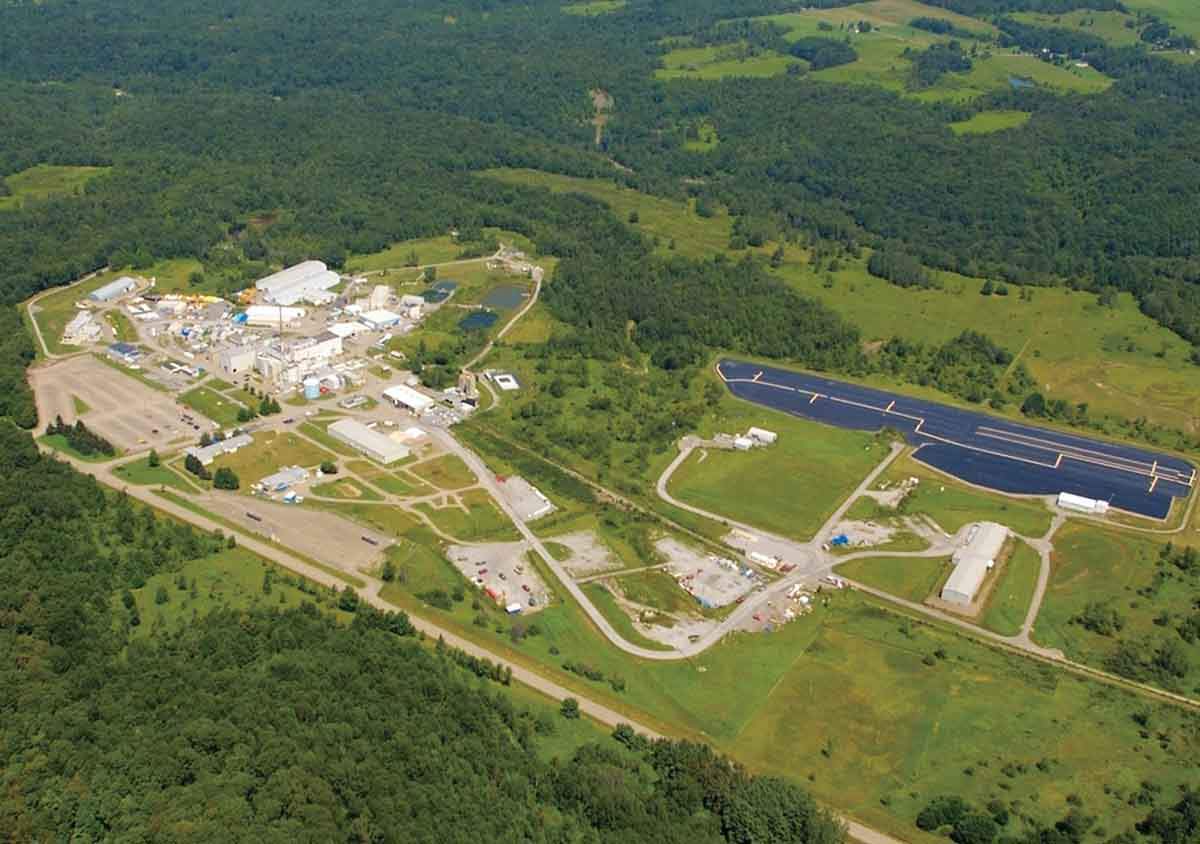
(Pictured: Ariel View of West Valley Demonstration Project.)
The state wanted to become a leader in reprocessing spent fuel and stimulate economic development based in an industry that was up and coming. The Nuclear Fuel Services, Inc. was created, operating the nation’s only commercial nuclear fuel reprocessing facility. The product was trucked to West Valley. Scientists were then charged with extracting usable materials such as uranium and plutonium from it.
France, England, and Japan are among the countries that currently recycle used nuclear fuel. They operate plants that are just like West Valley but on a much larger scale. That was the original mission of the West Valley plant when it opened in 1966, but in 1972 the Carter administration stopped reprocessing in the United States. They worried that commercial reprocessing fuel could lead to making weapons, with sales to rogue actors.
During those six years the West Valley site created a lot of waste, by some estimates over 600,000 gallons of high-level radioactive liquid, enough to fill an Olympic-sized swimming pool. The waste was stored in tanks, buried in the earth. Specialists at West Valley embarked on a massive project to retrieve the radioactive liquid and convert it into a solid, stable form. The liquid waste was carefully processed and immobilized within borosilicate glass—a material painstakingly engineered through years of research and international collaboration. The result: 275 stainless steel canisters filled with radioactive glass, designed to isolate dangerous materials for tens of thousands, or perhaps even hundreds of thousands of years.
Dr. James Marra, a Southwestern Central High School graduate, worked as an Advisory Engineer for Savannah River National Laboratory for twenty-six years specializing in immobilization of nuclear and hazardous wastes. He spent time at the West Valley plant. He says, “The tanks are empty now and the glass that was poured in stainless steel canisters are being stored there. And the glass is really good stuff!”
Marra continues, “A lot of resources have been spent to develop, characterize and study the behavior of the glass. In fact, the vast majority of that waste has been addressed through decades of hard work, scientific innovation, and hundreds of millions of dollars invested in developing safe solutions at West Valley and sites with similar waste across the country and the rest of the world. The glass is very durable and expected to maintain integrity for tens of thousands of years, without accounting for the stainless-steel canisters it is packed in.”
The story of West Valley is one of transformation, focused on environmental stewardship and technological innovation. It is a reminder that solving the nuclear waste challenge takes science, patience, collaboration, and a willingness to learn from global experience. West Valley, right here in Cattaraugus County, is a prototype, state-of-the-art project on the cutting edge of that challenge.