By Bill Burk
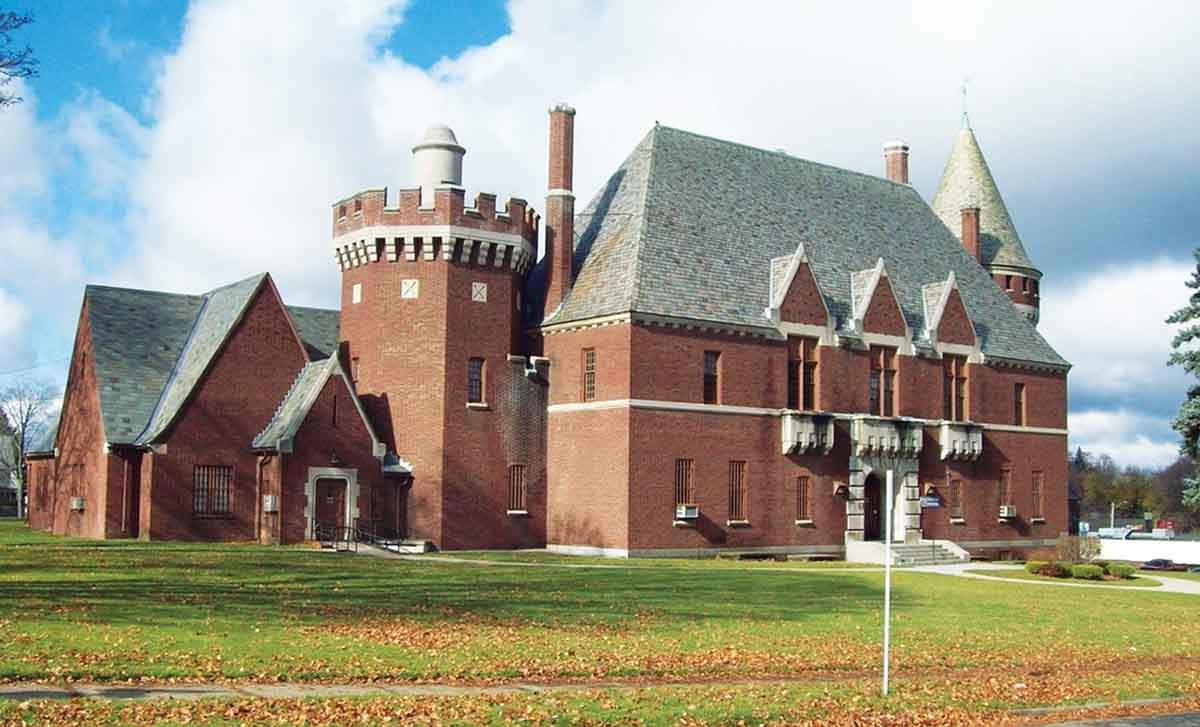
Perched on the bluff above the Chadakoin River in Jamestown, New York, is a castle. It has a courtyard, a great room, barracks, a turret cut with real archer’s crenels. Built in 1883, this fortress isn’t a medieval relic, archers never stood on the parapet firing flaming arrows at marauders. The building is Jamestown Armory—a stone, slate, and brick reminder that the nation’s big stories often come from small places.
The soldiers who would eventually staff the armory first earned their reputation before the building existed. In June 1863, a devastating summer for the United States Civil War, Company E of the 74th Regiment, made up of men recruited from western, New York, was ordered to Harrisburg, Pennsylvania as part of the Excelsior Brigade. They were sent to support Union forces fighting at Gettysburg. Over the course of the war the regiment fought at Fredericksburg, Chancellorsville, Spotsylvania Court House, and through the Siege of Petersburg.
When they came home to towns and farms across southwestern New York, they formed the Chautauqua County chapter of the National Guard. Between wars they stored weapons and trained at the Jamestown Armory, and at its counterpart in Dunkirk. Their management of the armory bridged eras, from the Civil War to the next major military engagement.
World War I was where Company E established its reputation and identity. Fighting as the 108th Infantry Regiment, 27th Division of the U.S. Army, Company E was assigned to the British Fourth Army and fought with distinction in one of the bloodiest, and most decisive actions for American soldiers in the war.
In September 1918, German positions near St. Quentin Canal were considered impenetrable. As members of Company E charged the canal, soldiers were caught in a killing zone from machine guns hidden in concrete pillboxes. In the chaos of clearing the area, units became intermixed, losing contact with command. Coordinated artillery and movement became impossible. The ensuing slog forced the patrol into close quarter fighting with grenades and bayonets, brutal hand-to-hand combat in the dugouts and tunnels carved into the countryside by the Germans.
For this campaign, Company E would have been at rifle company strength. 150-200 men from Chautauqua County fighting side by side. The company likely suffered 50% casualties (there were 8,000 total casualties in the battle recorded over three days of fighting).
to military continuity. It stands above the river like a bookmark in a long
American story, reminding anyone who sees it that the currents of history run
through places like Jamestown, carried forward by ordinary people who did
extraordinary things.
By the end of the “war to end all wars”, about 4,000 residents of Chautauqua County had served in uniform. At least 141 died. The men who returned to the Armory were decommissioned and returned to National Guard status, and Company E of Chautauqua County was a decorated unit in the U.S. Army.
In 1940 World War II was being fought in Europe. Jamestown and Dunkirk National Guard companies were again federalized, this time as members of the 174th Infantry Regimen. They were sent to Fort Dix for training in New Jersey. When Peal Harbor happened, their service was extended for the duration of the war. Most were used for home defense and as a replacement pool; individuals were deployed into other divisions across the war. The vast majority of the 8,500 Jamestown residents who served in WWII did so in thousands of different units across the Army, Navy, Marines, and Army Air Forces.
Back home, the entire county mobilized. The American Locomotive Company in Dunkirk pivoted from engines to M3 Stuart tanks. Factories in Jamestown, Silver Creek, and Falconer turned out airplane parts, ammunition crates, and sturdy furniture for barracks. The grape and dairy farms that denominate the county helped feed the troops.
For Vietnam, the pattern shifted. The National Guard wasn’t mobilized on the sweeping scale of the World Wars. Most men from the area who served in Vietnam were draftees or enlistees. They were assigned to units already in Southeast Asia. There was no single “Jamestown company”.
The armory remains, with its feudal architecture and medieval features, a monument to military continuity. It stands above the river like a bookmark in a long American story, reminding anyone who sees it that the currents of history run through places like Jamestown, carried forward by ordinary people who did extraordinary things.