
By Carol Fisher Linn
“Searching for Bigfoot… well, big folks from another era”
The WNY region has a colorful history. The earliest Western New Yorkers were believed to be the Clovis people around 10,000 B.C. after the glacial retreat. The Lamokas followed (3500-2500 B.C.) who sustained themselves in the wilderness with hunting and foraging. They moved on or were defeated by the Hopewell Indians who flourished in this region around 300AD. They were masters in copper work and in carving stone. Although craftsmen, it is assumed that it was the Hopewell who were likely the first large-scale farmers in the region. Archeological digs show evidence of corn fields in the rich Genesee River floodplain. Over the next 1000 years, the Iroquois settled in the area. Most natives lived south of present day 5 & 20 keeping families far from the warpaths along the Great Lakes. But, of course, as in many families, disputes drove a division between the separate tribes. WNY became the land of the Seneca. With the continued squabbling, the Peace Mother was given the task of solving it. She a wise woman named Jikohnsaseh (from the Neutral tribe near Lake Erie) and the result was the Great Law of Peace which formed the Iroquois Confederacy with the Senecas designated the “Keeper of the Western Door.” Centuries later, in the 1600’s Europeans came along devastating the Iroquois people. Since then, they have survived and have a peaceful co-existence with the white people regardless of mistreatment and broken treaties.
But are those ancients really gone? Gracious, NASA has recently even unveiled information about an unusual rock found on Mars by Perseverance which gives them indication that life may have existed on Mars. With that in mind, if we search closely enough, we too can find remnants of ancient life right here on earth. Close to home in Cattaraugus County, in Randolph, workmen found the most complete mammoth specimen ever found in NYS, believed to be a rare Columbian Mammoth (about 16,000 years – it predates the establishment of humans in North America.) Interestingly, Columbian mammoth remains have been found in association with Clovis culture artifacts who were said to have lived in this region. The Columbian mammoth can be seen today at the Randolph public library. There was also a gigantic mound in the center of the old village which was excavated around 1850. Three skeletons were found (alas they crumbled to dust when exposed to the air). That mound is estimated to be over 1000 years old based on counting the rings of trees found over the site. At one point, Randolph was considered a capital of “the Mound Builders,” i.e., natives (prior to the Iroquois) who ceremoniously buried their privileged dead in mounds.
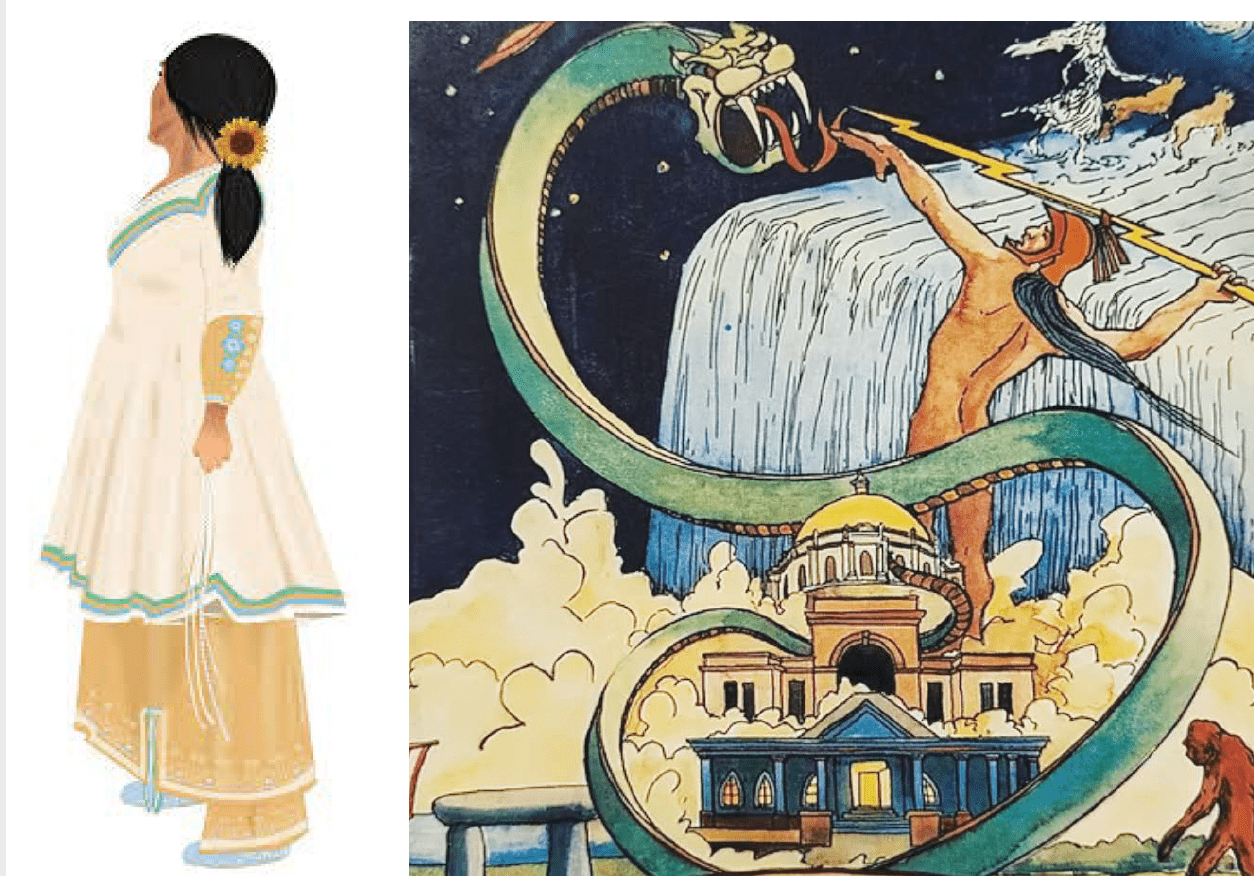
book by Mason Winfield (cover, top, right) “recycled reports that, in 1851, a farmer removing a stump within it turned up a trove of bones, some of them
huge. This was one of the sites in which the skeletal remains were sturdy enough to be examined and even handled.
A different kind of mammoth was allegedly found in Conewango Valley (home to the New York Amish near the Chautauqua County border). In Illustrations of the Ancient Monuments of Western New York, T. Apoleon Cheney mentions a twelve-foot high elliptical mound above Cattaraugus County’s Conewango Creek that held eight big skeletons. Most crumbled at the first touch, but a thigh bone lasted long enough to be measured. It was twenty-eight inches long. Doing the math, a thighbone size can be multiplied by four to get the relative size of the human it belongs to. 28×4=112inches = 9’4” These were likely some of those giants we hear about in these parts.
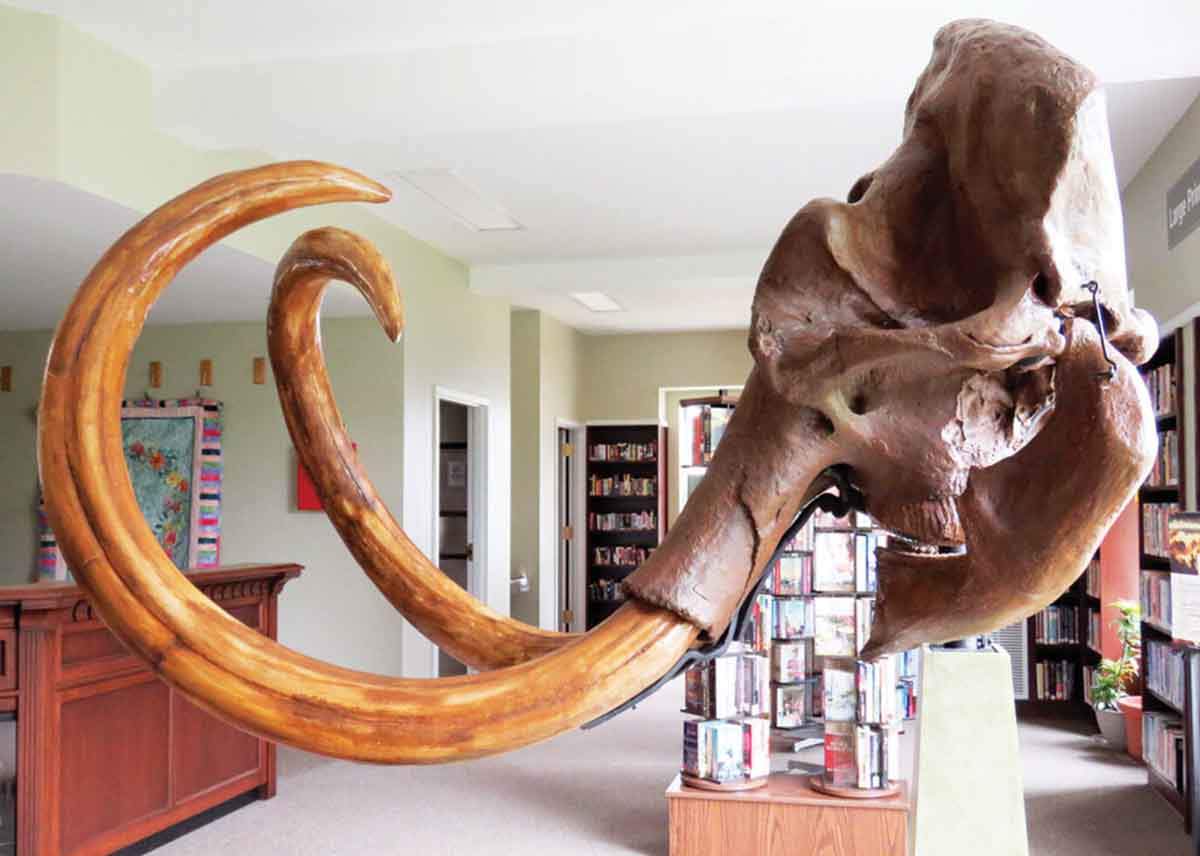
be a rare Columbian Mammoth (about 16,000 years – it predates the establishment of humans in North America.) Interestingly, Columbian
mammoth remains have been found in association with Clovis culture artifacts who were said
to have lived in this region. The Columbian mammoth can be seen today at the Randolph public
library (pictured).
This writer has long been told that that Limestone is another home of the Big People. This, again from Cheney, tells us that about five miles southeast of Salamanca is Carrollton, a Cattaraugus County town alongside the Allegany River. “Fort Limestone” was an egg-shaped earthwork that enclosed five Carrollton acres. Shadows of the Western Door, a book by Mason Winfield “recycled reports that, in 1851, a farmer removing a stump within it turned up a trove of bones, some of them huge. This was one of the sites in which the skeletal remains were sturdy enough to be examined and even handled. One Franklinville resident named Marvin Older paraded about the excavation site wearing a skull like a football helmet. A shinbone went from his ankle to well over his knee, and a rib curved all the way around him. It’s hard to argue that people were mistaken about the size of the finds.” … “Incidentally, a peculiar but precise egglike shape called “the flattened oval” was virtually standardized for some of the stone circles of England.
If you have any desire to see what these giants may have looked like, please visit the Cattaraugus County Museum in Machias to see a wooden prototype. Many thanks go to abovementioned author Mason Winfield for his corroboration and conversation for this article.